


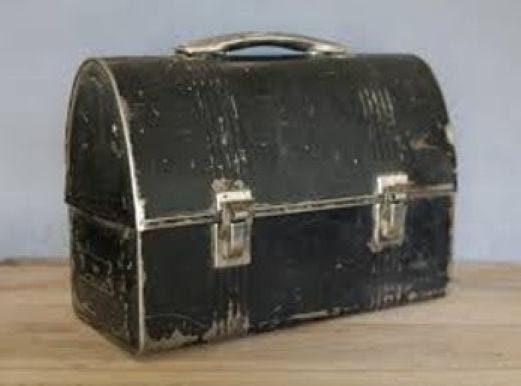
A FRIEND WHOSE father was a doctor tells me her family decided his medical bag would be passed down to the son or daughter who followed in his professional footsteps. All of his four children pursued vocations outside medicine so the bag eventually went to a granddaughter. The story made me think of my father’s black lunch bucket, I guess because it’s what I saw him carry back and forth to work every day.
I remember the oily smell of the bucket (my father worked at Imperial Oil in Sarnia) and its intricate shiny buckles. Also, its promise of leftover treats for us kids to fight over (some licorice or hickory sticks if we were lucky). It brought to mind as well the uneven rhythm and household chaos of those childhood days with Dad working shifts and Mom at home managing five children and everything else.
My father worked in ‘chemical valley’, a 25-square-kilometre stretch along the St. Clair River that has been home to more than 60 companies, and about 40 per cent of Canada’s petrochemical industry, the big names being Imperial Oil, Dow Chemical, and Polymer. Known as Canada’s first oil boom town, Sarnia is now becoming a bio-economy hub. But to this day, a blue-collar job in one of Sarnia’s chemical valley plants is still considered a coup for the security and benefits it offers.
Being part of the plants’ ‘lunch-bucket brigade’ meant my family could live in a house built by Dad and his brothers in Sarnia’s preferred north end on the shores of Lake Huron, away from the pollution and stink of the plants.
Triple time and a half
Dad worked three shifts: 7 to 3; 3 to 11; and 11 to 7, His schedule changed weekly. Imperial Oil often called at the last minute asking him to work a different or an extra shift. He never said no because we needed the money. I got used to hearing him and my mother talk about double time, triple time and even triple-time-and-a-half for working overtime on a holiday, manna from heaven. We kids got used to Mom hushing us throughout the day, reminding us, ’Be quiet, your father’s trying to sleep.’
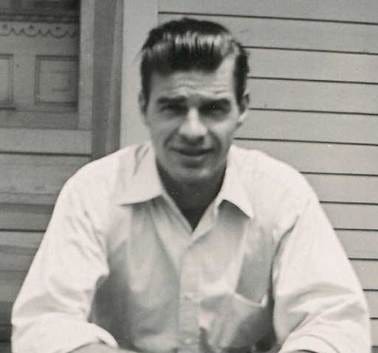
Keeping track of Dad’s schedule wasn’t easy for a kid. He drifted, at random it seemed, in and out of our lives. His comings and goings are some of my most vivid childhood memories: All of us peering impatiently out the big front window at 6:30 on Christmas morning waiting for Dad to get home from the night shift; pulling my bedroom curtain aside at dawn and seeing my father, just home from work, watering our backyard skating rink; listening to his whistling coming up the walkway when home from work, sometimes in midafternoon, sometimes at midnight.
Dad’s erratic shiftwork regime and sleep deprivation was more Mom’s concern (and mine as the fretful eldest daughter) than Dad’s. He’d forgo sleep any time there was something better to do, including family card games lasting into the wee hours or late-night talks with a kid just home from university for the weekend. “You have to be at work in a few hours, Johnny. Shouldn’t you get to bed,” my mother would nudge.
Dad didn’t like his job. He did it for the lifestyle and opportunities it afforded his family. We grew up only a few steps away from a beautiful stretch of beach. On our affluent stretch of Lakeshore Road, our neighbourhood friends were sons and daughters of lawyers, doctors, judges, teachers and company bosses. They expected to go to university and so we did too.
A Pythagorean Theorem ruse
It horrifies me now to remember the shame I felt when I couldn’t easily describe my father’s job to my friends. Even worse is the thought that he ever felt that from me. In fact, we all lavishly adored him, which I think must have at times irked our ever-present, exhausted mother. My two brothers worshipped Dad and, to this day, I see how each of them models him in their own way. My two sisters and I always wanted more of his time and attention. Once, in a bid to spend an afternoon with him, I convinced him that my high school grasp of the Pythagorean Theorem could help determine dimensions and angles for the screened porch he was building for a neighbor. I got to tag along, but we both knew it was a ruse.
I only recently learned that Dad was called a “pumpman” at work. As orders came in, he’d helped direct the flow of oil in specified volumes through the myriad tanks and pipes to a prescribed destination. He was also, from time to time, put in charge of testing gas levels in the massive oil storage tanks prior to any work being done on them. As a kid, when I pictured him at work, I’d see him climbing the steel steps that wound around the giant spherical oil tanks lining the river. I worried about how cold he would get when the winter winds were whipping off the river.
One memory stands out for all of us and, as adults, my siblings and I have often traded memories of the day Dad returned from work early, shaken and more upset than we’d ever seen him. Mom rushed some comforting soup to the table. I can still see his hand trembling while lifting the soup spoon to his mouth.
I still don’t know exactly what happened. It had to do with an explosion at work that day that left a man dead. A day or so later, a company man in a black suit carrying a briefcase arrived in our living room. Sensing danger, we children instinctively gathered and stood as sentinels around Dad in his chair until my mother ushered us away. Dad was eventually fully exonerated from having any responsibility for the accident.
Unlike some people who fade after retirement, Dad thrived on the found time. He built exquisitely beautiful furniture; roll-top desks, harvest tables, corner cabinets, nestle end tables. One Christmas, he made beautifully upholstered foot stools for each of his daughters. He fixed whatever needed fixing or redone in our house, and in the houses of friends and relatives. He drove east or west with Mom to visit one of us kids. He didn’t like to travel but once begrudgingly flew with my mother to Hawaii and declared it the closest you could get to heaven.
Briefcase? No thanks
I later learned that Dad could have traded in his lunch bucket for a briefcase. Imperial Oil bosses asked him several times over the years to take a supervisor position. He wasn’t interested. I am only guessing, but I think he felt he had enough on his hands trying to keep all of us at home happy without taking on more of the same responsibilities at work. I think, too, that he was just plain uneasy with the idea of being someone’s boss. One of 10 children raised under an authoritarian father, he’d had enough of hierarchy.
I’m glad he didn’t succumb to the pressure to become someone he wasn’t. He would have been a different kind of father and I would be different too. I like knowing that my achievements are my own, not enabled through connections or nepotism. It’s a special kind of superpower.
When I told a brother that I was thinking of writing something about Dad as a Father’s Day tribute, he said, “just remember he wore a cape”. It was both a joke and a gentle rebuke. Could he trust me in excavating this sacred territory?
One more memory about that bucket. Apparently, as a kid I once slipped a crayoned note into it saying, ‘I lov yoo Dad sined Anne Marie.’ I discovered that note when going through his wallet a few days after he died.